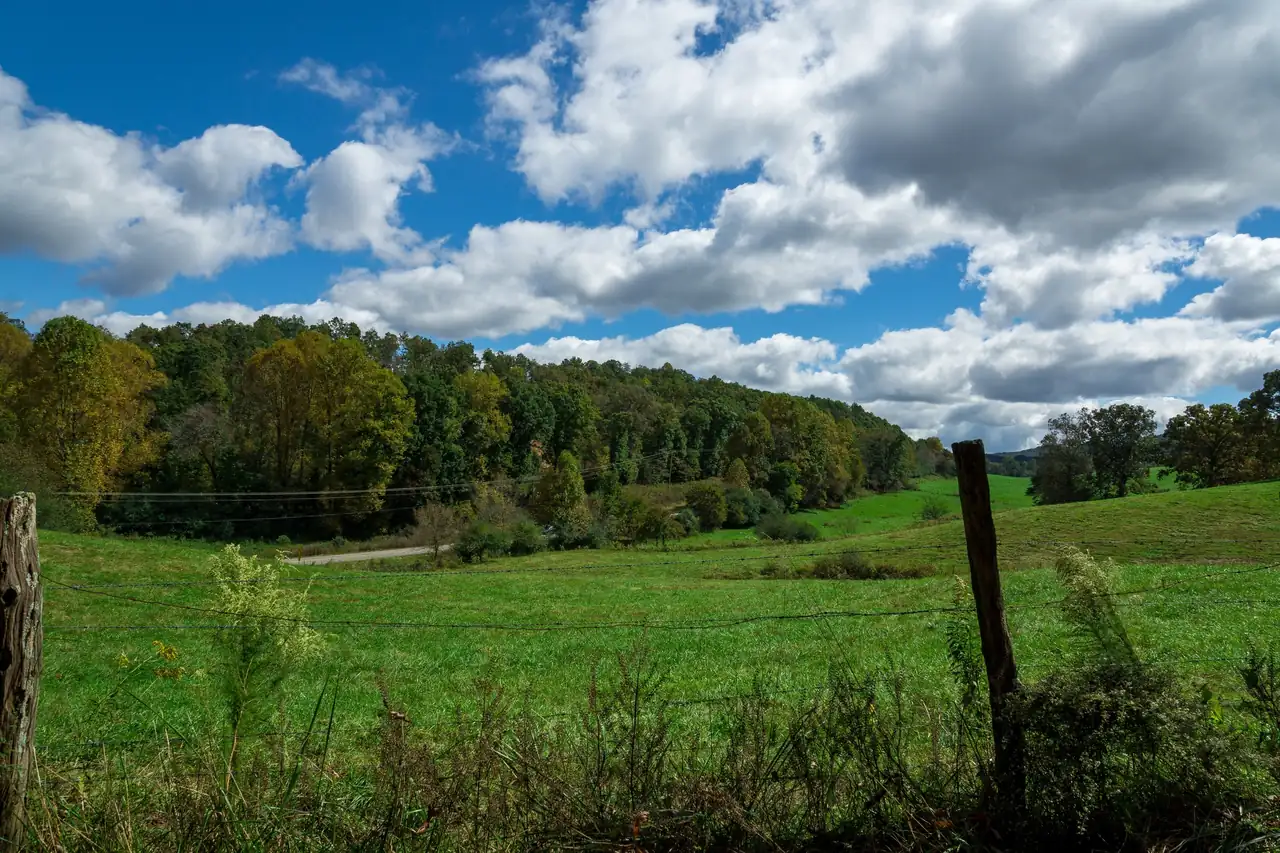
Yes. Most of the Cartecay River in Gilmer County, Georgia runs through private land, and riverfront lots and homes do change hands. American Whitewater describes the middle stretch as a residential area where most banks are private property. Owning a piece of that bank comes with a state stream buffer, federal flood maps and county permits, each run by a different office.
The banks are private, and floaters pass in summer
The tubing outfitter on Highway 52 East tells its riders there is nowhere to get out because both sides of the river are privately owned, and it runs from Memorial Day to Labor Day. If a lot sits on a float route, expect tubes and kayaks going by in season. The tubing guide shows where they run, and river access covers the one state-run public launch.
Stream buffers: 25 feet in Georgia, 50 on the Cartecay
Georgia sets a 25-foot buffer along the banks of all state waters, measured from the point where vegetation has been wrested by normal stream flow. Along trout streams the buffer is 50 feet. That matters here, because Georgia’s water-quality rules designate the Cartecay as trout water for its whole length in Gilmer County:
- Primary Trout Waters: the Cartecay watershed upstream from the mouth of Clear Creek, which USGS places at about 34.6273 N, 84.4385 W.
- Secondary Trout Waters: every other Gilmer County stream, including the Cartecay below Clear Creek. The exceptions are the Coosawattee below the Ga. Hwy. 5 bridge and Talking Rock Creek.
Read together, those rules mean the 50-foot trout-stream buffer, not the 25-foot one, generally applies along the Cartecay and its Gilmer tributaries. That’s our reading, so confirm it for your parcel with Gilmer County Planning & Zoning or EPD. Small trout streams averaging 25 gallons a minute or less have a general variance for piping, so a side creek can come out differently.
Because the Cartecay and its Gilmer County tributaries are designated primary or secondary trout waters, the 50-foot trout-stream buffer, not the 25-foot buffer, is the one that generally applies along them. (This is our reading of the two rules together; confirm for a specific parcel with Gilmer County Planning & Zoning or EPD.) (Georgia EPD rules, checked Oct 18, 2026)
Inside the buffer, the natural vegetation stays. Encroaching generally takes a buffer variance, and in Gilmer County a land-disturbing permit inside the 50-foot buffer needs an Application for a 50 Foot Vegetative Buffer Encroachment, filed with EPD’s Erosion and Sedimentation Control Unit. The county’s erosion ordinance repeats one state exception: someone building a single-family home to live in may thin or trim buffer vegetation if protective cover and enough canopy to shade the stream remain. Ponds need EPD approval on either kind of trout water, and on Primary Trout Waters only streams draining under 50 acres can be dammed at all.
County permits before you clear or build
In unincorporated Gilmer County, Planning & Zoning (1 Broad Street, Suite 002, Ellijay; 706-635-3406) issues building permits, and you need one before construction or excavation starts. Section 70-39 of the county code requires a permit before any land-disturbing activity, with five copies of an erosion and sedimentation control plan. Land at 2,200 feet or higher with slopes of 25 percent or more is in a mountain protection district. After the permit, the E911 Addressing Center (706-635-4653) assigns the address. Ellijay and East Ellijay run their own permitting inside city limits.
Floodplain: check the map, then the permit
All construction in Gilmer County must follow Chapter 74 (Floods) of the county code. For land in the 1% flood plain, the county’s floodplain checklist sets the order:
- Get a septic permit from Environmental Health (706-635-6050).
- Meet with Planning & Zoning, which looks at the property and goes over the flood plain ordinance.
- Have a survey plat showing the floodplain boundary and the proposed home site.
- Provide two elevation certificates: one before the footing inspection and one before the final.
Gilmer County requires two elevation certificates for a structure in a flood plain: one before the footing inspection and one before the final inspection. (Gilmer County, checked Oct 18, 2026)
To see the map, search the address on FEMA’s Flood Map Service Center. FEMA lists April 17, 2012 as the effective map date for Gilmer County, Ellijay and East Ellijay, and all three take part in the National Flood Insurance Program (OpenFEMA). Zones that start with A are high risk, and flood insurance is mandatory there with a government-backed mortgage. Most homeowners policies exclude flood. NFIP coverage generally starts 30 days after purchase and caps at $250,000 for the building and $100,000 for contents (FloodSmart). If the property ever got federal disaster aid, the flood insurance requirement stays with it after a sale. If the map looks wrong for your lot, FEMA takes requests to amend it.
Septic, wells and utilities
A permit is required before any septic system is installed, added to, modified or repaired, and each county board of health sets its own lot sizes. Records aren’t online, but owners and buyers can ask Gilmer County Environmental Health (1 Broad Street, Suite 003; weekdays 8 to 4:30) for a property’s records, if any exist.
Public water and sewer come from the Ellijay-Gilmer County Water & Sewerage Authority, 1023 Progress Road. Where there’s no service, confirm availability, then apply for a new meter and pay tap and impact fees. Where a meter exists, new customers pay a $175 connection fee plus a deposit. On a well, Georgia DPH recommends a bacterial test every year and a W33C chemical screen every three years. UGA Extension Gilmer (28 Southside Church Street; 706-635-4426) sells well tests from $30 to $100. For internet, put the exact address into the FCC National Broadband Map.
Renting it out: the rules, not the math
This guide makes no short-term rental income claims. These are the rules. Chapter 45, the county’s host license ordinance, covers stays of 30 consecutive days or less in unincorporated Gilmer County, not inside Ellijay or East Ellijay.
- Each unit needs its own host license, $225 new or $300 to renew, per the county’s STR portal. Licenses expire December 31 and don’t transfer to a new owner.
- Maximum occupancy is two people per bedroom plus two.
- A responsible party must be on call 24/7 and answer complaints within four hours, and owners send good-neighbor letters to owners within 250 feet.
- Every ad must show the license number ($250 per violation), and operating without a license is a $900 fine.
- Hosts report hotel/motel tax every month that rentals occur.
The county held a public hearing on October 14, 2026 on amendments, and we couldn’t confirm adoption when we checked. Call the help desk (888-751-1911) before you plan around any of it.
Property tax basics
The Georgia Department of Revenue‘s standard homestead exemption takes $2,000 off the 40% assessed value for county and school taxes. You must have owned and lived in the home on January 1, and applications are generally due April 1, or by the end of your 45-day appeal window. Owners 62 or older with household income of $30,000 or less can get a floating county exemption. The Tax Assessor (706-276-2742) handles exemptions; the Tax Commissioner (706-635-4762) collects. For 2026, commissioners tentatively adopted a county M&O rate of 6.079 mills against a 5.639 rollback. We didn’t find the final rate, and school and city rates are separate.
Run the checklist
Work through these questions on any lot or house before you make an offer.
Decision tool · riverfront buyers
Before you buy on the Cartecay: 13 things to settle
Riverfront here is private land with state buffers, flood maps and county permits attached. Tick each question off as you get a real answer from the office named. Your progress stays in this browser only.
All 13 settled. Gold Peach Realty can walk you through homes near the Cartecay and what each one's frontage, flood map and permits look like.
Rules change: each answer links to the office or agency that publishes it, checked October 18, 2026. This checklist is general information, not legal, survey or insurance advice.
Ready to look? Homes near the Cartecay shows what Gold Peach Realty has listed, and selling a home covers the other side.
Questions people ask
Can you own land on the Cartecay River?
Yes. American Whitewater describes the middle Cartecay as a residential area where most banks are private property, and riverfront land changes hands like any other. Ownership comes with a state stream buffer, flood maps and county permits.
Source: American Whitewater, checked Oct 18, 2026
How wide is the stream buffer on the Cartecay River?
Georgia's baseline buffer is 25 feet, but trout streams get 50 feet, and the Cartecay is designated trout water in Gilmer County: primary above the mouth of Clear Creek, secondary below it. So the 50-foot buffer generally applies; confirm it for a specific parcel with Gilmer County Planning & Zoning or EPD.
Source: Georgia EPD rules, checked Oct 18, 2026
Do I need a permit to build in the floodplain in Gilmer County?
Yes. The county's checklist starts with a septic permit, then a meeting with Planning & Zoning (706-635-3406), a survey plat showing the floodplain boundary, and two elevation certificates, one before the footing inspection and one before the final.
Source: Gilmer County, checked Oct 18, 2026
How do I check if a property near the Cartecay is in a flood zone?
Search the address on FEMA's Flood Map Service Center at msc.fema.gov, the official source for flood insurance maps. FEMA lists April 17, 2012 as the effective map date for Gilmer County, Ellijay and East Ellijay.
Source: FEMA, checked Oct 18, 2026
Do you need a license to rent out a home in Gilmer County?
In unincorporated Gilmer County, yes: rentals of 30 days or less need a county host license for each unit, $225 new and $300 to renew. Amendments to the ordinance went to a public hearing on October 14, 2026 and were not confirmed as adopted when we checked.
Source: Gilmer County STR portal, checked Oct 18, 2026
What is the homestead exemption in Gilmer County, Georgia?
Georgia's standard homestead exemption takes $2,000 off the 40% assessed value of an owner-occupied home for county and school taxes. You must have owned and lived in the home on January 1, and applications are generally due by April 1.
Source: Georgia DOR, checked Oct 18, 2026